food

FOOD

EN

I didn’t eat much Japanese food growing up. Born hapa Yonsei of a second generation German American mother and third generation Japanese American father who’d grown up together in the “old neighborhood” of Lakeview, Chicago, circumstances didn’t dictate much knowledge of overt Japanese customs, culinary or otherwise.

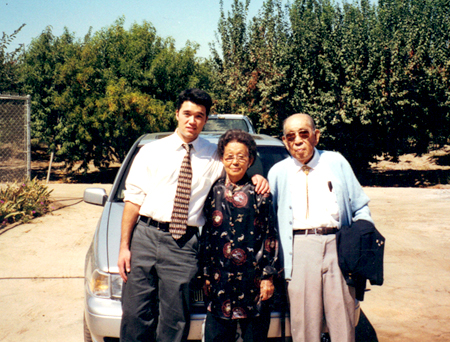
Hiraoka Ranch. Fowler, CA

Our family emigrated from Kyushu in the early 1900s, farmers who plied their trade in California’s Central Valley, culminating in ownership of acreage purchased under the names of their American-born Nisei infants due to the California Alien Land Law that prohibited “aliens ineligible for citizenship” from owning land or even leasing it for a period exceeding three years. “Jus Soli” provided them a loophole whereby they could eventually own property some twenty years post-arrival.

My Nisei grandparents were raised in the neighboring communities of Fowler and Del Rey, roughly ten miles south of Fresno, CA. Post-evacuation, from the Gila River War Relocation Center they further relocated to the Midwest, where they were officially advised to not congregate among other Japanese Americans. On a personal level, they felt the insular Japanese communities of their West Coast upbringing—although social conditions of the day did not provide for integration—contributed to the conditions leading to Executive Order 9066, and as such they had no ambition to reassociate with the larger JA community. Although they grew up speaking Japanese, in their quest to provide their offspring with a “true” American upbringing, they never spoke it to their children. My mother’s parents who had emigrated from Germany pre-WWII—and particularly since my grandfather had fought for the Kaiser’s army during WWI—never spoke the German language to their children for the same reason.

To appease my father, my mother did mostly cook rice for our meals instead of potatoes, and that was about it. We never went to Japanese restaurants. When West Coast family came into town we went out for China Meshi. JA family funerals were concluded over China Meshi. And the times I can remember visiting relatives on the family farm in Fowler during my childhood, my Nisei aunts cooked…Mexican food.

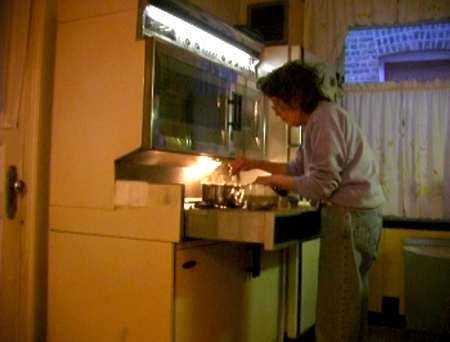
Matsunaga Kitchen. Chicago, IL

My grandmother once told me that aside from theinaka-style okazu dishes they grew up on, because they worked side-by-side in the fields with Mexican laborers and would trade recipes, most Japanese in their community knew how to cook Mexican dishes. Special days at my bachan’s house in Chicago were when we walked into her cooking up a batch of enchiladas or tamales. I often wonder if they altered the recipes for their palate or if nostalgia clouds my taste buds, because I’ve never tasted Mexican food from either a restaurant or prepared by Mexican family friends or coworkers that carried the same flavor as California inaka Nisei adaptations.

To this effect, I wonder if Mexican culinary traditions within the California Japanese American agricultural community couldn’t be considered Nikkei cuisine. Because as a disconnected Midwestern JA lacking any sense of a Japanese upbringing, although I was privy to my Nisei grandmother’s inaka-style Japanese American “slop” handed down from her mother likely from the nethers of the southwestern Japanese countryside, my taste memories of what I consider our family’s JA roots are found in the kitchen booth of a Fowler farmhouse over a plate of homecooked red sauce enchiladas with freshly picked apricots for dessert.

*This article was originally published in Voices of Chicago, online journal of the Chicago Japanese American Historical Society on July 3, 2012.

© 2012 Erik Matsunaga

Growing Up Sansei in Chicago by Keith Uchima

Normally, I am a fearless writer, but this commission from the Chicago Japanese American Historical Society (CJAHS) has created endless procrastination, writer’s block and even fear for this author. For months, I could not figure out why- but today, it hit me. My generation is hard to define. We’re not supposed to be “too open,” show our emotions or attract attention- all cultural remnants from being racially profiled in America during WWII. We Sansei (Third Generation Japanese American) are furthering the transition that our parents (Nisei) and grandparents (Issei) pioneered, yet we remain largely invisible. Our assimilation is relatively smooth. Our attempt at not drawing too much attention to ourselves has been successful, perhaps to a fault. As our society becomes truly integrated, there are a certain percentage of us Japanese Americans (JA’s)-who assimilate well enough to “dissolve.” That is, to integrate well enough remove one’s self from the Japanese American community entirely. Herein lies the conflict. Is this success? Many of us marry partners from another ethnic group/heritage.

My lovely wife Betty has her own amazing stories from her Chinese American perspective that are indeed worthy of “Joy Luck Club II.” As this wonderful integration progresses, there is always riches gained and treasures lost. There is so much that we Sansei have seen as the bridge from the old thinking to the new. Frankly, there is no way to nail down all the complexity and diversity of the Japanese American existence since the exodus from the U.S. prison camps as WW II ended, so I decided to simplify and tell the story from my perceptions as a child growing up in the community…

It’s the little things. The memory flashes. The swatches of people and events. The smell of Bachan’s (Grandmother’s) cooking on New Year’s Day. The sound of Hawaiian ex-G.I.’s singing and strumming their ukuleles- drunken, lovelorn and red-faced from the beers I brought to them at the holiday parties. The contrasts. The “Jekyll and Hyde existence” of watching “The Dick Van Dyke Show” or “I Love Lucy” then going down to the Buddhist Temple of Chicago (B.T.C.) to watch the Obon dance. Those weird, “tinny” Japanese records playing through those piercing gray metal speaker cones in the middle of Leland Avenue. Who could forget that crazy Nihonjin (Japanese) taiko drummer with the kamikaze headband who performed in such a lovely maniacal fashion up on the platform? Entire troops of Japanese American boy scouts and cub scouts. How about the Grant Park softball diamonds on a summer Sunday completely overrun by JA’s? Unique to us? Definitely. How do I begin to describe those experiences to my kids?

My mother Ruth came to Chicago with her mother and brother straight from Manzanar after WW II ended. It is tempting to go into the internment issue, but I am certain that the subject has been covered with greater skill and detail that I could ever recreate second hand.
My father Kurt left his home in Honolulu to get his Master of Arts from the University of Colorado before the events at Pearl Harbor. He fell in love with the mainland. His existence during WW II was less affected since he was inland, but nevertheless, he tread carefully during the war years at college. He decided to come to Chicago after the war. The “buzz” was that there were jobs for Japanese Americans. Factory jobs, but what else could they do? Being Japanese American made you a suspect of treason, way before this concept of “racial profiling” even existed.

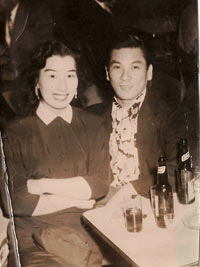
It was in Chicago where my parents met. Their first date was a movie at the Uptown Theater, and dancing at the Aragon Ballroom. What a glorious evening that must’ve been. Given the times, they were pretty hip, because I have seen some pretty slick photos of them “clubbing” at Club DeLisa on the South Side, where they would listen to legends like Billy Eckstein, Ella Fitzgerald and Sarah Vaughn. The photos show my mom all “dolled up” and my dad in a very sharp suit with pomade slicking back his jet-black hair. All the women at the table have Joan Crawford hairdos- and there is a huge bottle of Seagram’s on the table. Hmm. There is a lot I still don’t know about them! They married and settled on Elm Street, eventually moving to Oak Street at Clark.

After a series of factory jobs, my folks took a brave risk and bought Kurt and Ruth Dry Cleaners on the 1100 block of N. Dearborn. Clark and Division streets were humming with activity. While the majority of Nisei were busy trying to assimilate and make ends meet, there was a rogue group of young Nisei men who took a different route. It was around this time when the legendary Nisei gangster Montana Joe, a.k.a. Ken Eto, was making his mark around Clark and Division. Some forty years later, I chronicled his rise and fall in the play “Seven Out.” When I was researching the drama, I was told about the Nisei-run gambling house in back of the barber shop at Clark and Maple. Montana Joe and some of the neighborhood Nisei fellas would help him run the joint. One day, one of Montana Joe’s top lieutenants came knocking on our back porch door. His hand was bloodied from some kind of brawl in the alley. My mom bandaged his hand and he was on his way. Just another day at Clark and Division.

In spite of all the vice in the neighborhood, it was a glorious time for kids. We didn’t know we were poor. Amidst the immigrants, down-and-outers, gangsters, call girls, Issei and Nisei, I rode my tricycle around that neighborhood as if I owned it. I can still recall the pungent smell of beer as I entered Bronco’s Anchor Bar. I can’t remember how or why I was allowed in there, but I can still envision exactly how it looked and smelled.

My sister Karen remembers going on dry cleaning deliveries with my dad. I have heard tales of dad getting winks and generous tips from the platinum blond showgirls who strutted across the stage at Talk of the Town -as he delivered their sequined gowns!

Karen was a bit older and was a lot more aware of the difficulties, racism, and corruption, but I was just a kid who thought all of this was normal. Years later, she would tell me tales about what she observed at the colorful local joints called Ting-a-ling, Rainbow Restaurant, Ding Ho, and the Rib House.

Although most of our dads managed to stay on the straight and narrow, many of them would sneak off occasionally and play some “pai que” or “bak a pei”- Chinese gambling games, or run off to the track when one of the guys got a “hot tip” from Montana Joe’s crew.

This was a wild, wooly and rich time in Chicago’s history. The politicians and big shots were not ashamed to run the show any way they seemed fit. As soon as we could afford it, we moved further north to a little “island” in Uptown- The Morioka’s 6 flat at Kenmore and Wilson. Karen attended Senn High School and became very involved with the plight of Chicago’s impoverished. She joined the original Uptown Peoples Planning Coalition started by Chuck Geary, a political activist. It was the sixties and, through her, I learned about the Beatles, John Kennedy, Simon and Garfunkle, the Hippies, the Yippies, Abby Hoffman and the Chicago Seven.

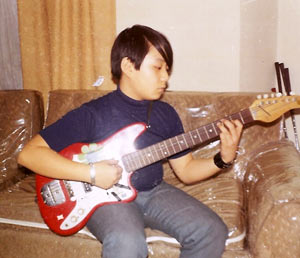
After Karen made the entire family sit in front of the TV to watch the Beatles on “The Ed Sullivan Show,” I grabbed my dad’s old Gibson guitar and started playing. Being a super cool sister, she took me to the Amphitheater to see a WLS rock music convention. I saw Tommy James and the Shondells, the Troggs, Paul Revere and the Raiders and a slew of others. I was grateful for that. What big sister would voluntarily bring her little brother to a concert? Music became my passion.

For the most part, I believe that my generation was relatively happy and carefree. I was going to the cub scouts at B.T.C. and occasionally ditched scouting to watch “The Partridge Family” and “The Brady Bunch” on Friday nights. Stewart School in Uptown was made up of the most diverse ethnic makeup I have ever seen. Appalachian whites from the mountains, blacks from the South, Hispanics, Asians and, among others, a rare and slowly fading population of American Indian kids. We were all tossed together in this incredible melting pot on the north side called Uptown. Only in my adulthood did I realize how privileged I was to be exposed to this diversity. It was around this time when there was a huge influx of East Indian and Korean immigrants as well.

When I think of my youth in the 60’s, the following images appear:

It’s a perfect summer in Chicago and school is out. There is an apartment building in Uptown -just like hundreds of others except one unusual thing: every single apartment is occupied by a Japanese American family. Through some kind of miracle, almost every household in this six-flat had boys pretty close to my age. If this were a Scorcese film, the camera would be panning across these faces: There was Donny and “Kenbo,” Bobby and Brian, Kirk, Nick and Dirk, and Darryl, Rusty and me. Nearby, there were other similar clusters of families. Let’s see. There was Kenny, Keith, Steve and Scotty, Kevin and Colin, and Frankie and Russell.

Unbelievable when you think about it. There was always someone to play with. Always someone to get into trouble with, too! There was: softball at Grant Park; basketball at Olivet Institute’s gym or out back with the African American kids; bowling at Marigold and the Bowlium; hockey in the icy alley in the winter; and of course, Cub Scouts at the Temple and Boy Scouts at Owassippe, not to mention all the illegal fireworks in the summer. Given our pyrotechnic experiments, it’s amazing we all still have our fingers!

So it’s the 60’s and there are these little “islands” of JA’s in the Uptown neighborhood, but we were soon to discover that Hyde Park had the same thing going on. As most of you who hung around then can testify, all the young guys of all races connected on one thing… sports. And I gotta tell ya one amazing thing…

Outside of a few scrapes here and there, the entire multi-ethnic community pretty much got along back then. In fact, aside from the winos that slept in the vestibule of our apartment building, and getting my dad’s Delta 88 stolen and “torched” on the day of my Bachan’s funeral, we got through relatively unscathed!
Okay, back to Sunday morning… we chow down quickly, grab our softball mitts and jump into Big Donald Nishibayashi’s shiny white Ford Fury. No seatbelts and windows wide open as we squirmed around on the scorching hot red vinyl interior. Lake Shore Drive had a high speed limit and a very sharp “S” curve back then, but Big Donald always looked so confident as he slung that Ford down L.S.D. with 5 or 6 of us scrunched up in the back seat with our Beatles haircuts flapping in the wind. Back then, we always found street parking on Balbo near the diamonds. I think the meters cost five cents an hour. Currently, I believe it is five cents per second, but you must wait an hour to find one. Now here is the part that I’ve tried to explain to my two daughters…

Picture this: Sunday in Grant Park, we exit the car with all our softball gear, look out at the massive cluster of softball diamonds, and the entire field, as far as the eye can see- is swarming with hundreds of – not just Asian Americans, but Japanese Americans. Men’s teams, boys teams, ladies and girls teams, kiddie teams, and of course those evil, green-clad, semi-pro Galaxies! Frankly, I don’t even think we will ever see that again in Chicago. This was every Sunday during the summer. Even now, I can’t believe how us kids took this all for granted.

Good report cards were expected of us, but somewhere, somehow, it became all about the sports- another remnant of the camps, perhaps. What an amazing chance for us to feel as if we belonged to something bigger! A chance for all the churches to connect, a chance for all the community to express its competitive spirit, and most importantly, it gave us guys a chance to check out all the girls, because thank God/Buddha- Sundays were co-ed. Yes, let’s face it. Most of us adolescents were there for two reasons: 1. the joy of competition, and 2. mainly to check out which churches had the hottest looking girls. Am I wrong? And come to think of it, most of the girls were really good looking. Or perhaps I was hitting puberty at that time! The mind is a terrible thing to waste, neh?

Anyways, it was fast pitch windmill style softball and I loved playing catcher for my childhood friend Donny “Nish” who was arguably the fastest and most dangerous pitcher in the league. Some of the most talented, hardest hitters would tremble as he would wind up and fiercely deliver a searing fastball. The older kids could pick on us all they wanted the rest of the time, but when Donny and I wanted the pitch to come “way inside,” those guys gave us respect! I couldn’t hit very well, but I would gladly sacrifice my body as a catcher for the B.T.C. team! I actually attribute my recent knee surgery to the “joyful time” I spent getting banged up for the CNAA! My favorite sounds: 1. Donnie-boy’s hardest fastball slamming into my catcher’s mitt after striking out some cocky “A” league hot-shot, and 2. the sound of Pete Izui’s bat cracking the ball so hard -that the home run went clear past the OTHER diamond. Good times for sure.

My parents were still active socially -bowling at Marigold, golf with the Kamaiina club, (one of the 3 or 4 Asian-based golf clubs) and poker games. Ah, the poker games. The ear-shattering “clatter” of those cheap, plastic poker chips and the cackle of Nisei laughter which served as the background for whatever mischief us kids were trying to do.

Summer was full of fast-pitch at Stewart School, hittin’ golf balls at the driving range and picking horses with my dad at Sportsman’s Park. Winters were full of loud poker games for the parents, and us “punks” begging for quarters to blow in the hockey machine at Marigold bowl.

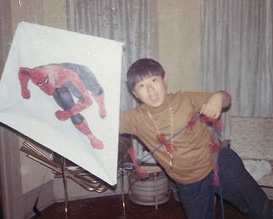
Oh yeah – the Cub Scouts and Boy Scouts. It was there where we met an entire South Side contingent of J.A.s. Much like the racially diverse neighborhoods on the north side, Hyde Park area seemed to be a safe place for post war Japanese Americans to settle. Camp Owasippe was an enlightening opportunity for us “city-rat” kids to learn about roughing it. After one day with the mosquitoes, most of us were ready to go home to mom’s cooking and TV, but we ended up joyfully watching the first moonwalk on the mess tent T.V. while drinking a beverage called “bug juice” instead! The pinewood derby was supposed to be for the boys. I carved the heck out of my crappy looking little car, but I was shocked to see that this was where some of the dads expressed their highly competitive nature by building their son’s little race cars as if their lives depended on winning. It’s hard to compete when other scouts are bringing in aerodynamically tested cars with spray painted graphics. One fine day, I won a “best design” for my Spider Man design at the kite flying contest at Cricket Hill. Later that day, I got mugged at the Museum of Science and Industry by some bigger kids. Ah, those fond scouting memories…

There were Christian, Buddhist and Presbyterian churches all tied together by ethnicity and culture. Very unique. There was BTC, MBT, CCP, Tri C, Lakeside and others. I know that many of our youth were driven by their faith, but to many of us, what mattered most was which church had the best teams and the coolest social climate. Or maybe it was just me who was so shallow, but I think not! Nevertheless, the Issei remained the backbone so that the Nisei could raise us in these “good times.”

During this stretch, the Resettler’s Picnic was going strong. We kids had no idea that the Resettler’s Picnic was a chance for all of those Nisei and Issei who were displaced by the relocation camps to gather. We just knew it was really great event with games, prizes, bento and most importantly, all those weird flavored canned sodas that we never got at home. Grape? Cream soda? As much as you could drink? Yes! – all those icy cans were sitting in those big metal tubs of ice water. Remember the feeling of dipping your arm in to get one? Priceless.

For 7th and 8th grade, many of us went to Stockton Uppergrade center, a block away from the current JASC building. More diversity. Older kids. Some of the neighborhood conflicts and issues became more serious for the kids as we all got older. Some innocence got lost at Stockton.

The frenzy to get into Lane Tech. This was the beginning of the Chicago High School fierce competition phenomenon. We knew of one father who went down on orientation day and tried to pay cash to get his kid into Lane. Now that I have two kids heading into high school, I realize that the high school has actually become MORE competitive. If I have grand kids, I will be sure and hire nursery school tutors so they can get their algebra/trig out of the way early!

It was around this time when I was getting involved in the music and theater community. Sadly, most of my early Sansei crew had become dispersed, and I was probably the most guilty since I started a long journey into the creative arts.
Perhaps the most amazing things I’ve discovered about getting older- is that I see myself acting more and more just like my late father, Kurt. You remember all those old guys who just sat around at Marigold “talking story?” Well, lately, whenever I run into someone from the old days, we get lost in reminiscing about our misadventures- who’s doing what, who’s still around, who’s disappeared, and lately – who died or who’s KID got divorced! Ai Ya! Here’s the kicker. I see my daughters standing around rolling their eyes in mockery, waiting impatiently for me- just like I used to wait around for my dad to finish “shooting the breeze.” My Bachan used to call this “Ba-chi,” loosely translated as “You shouldn’t have done that, see what karma you get?”

What will the next generation of Japanese Americans life bring? Will there be any traces of our unique history as our kids carry on? I only hope my daughters are able to find a rich and wonderful collection of memories that are as culturally meaningful and beautiful as mine.
This remembrance is dedicated with love to my parents: Kurt Toshiro, Ruth Chiyoko and “Bachan” Chiyo, and my sister Karen, who broke all the rules first- and “took the heat” so that I could have it a little easier.

Mom came full circle when she ended her journey in a hospital bed in the Barr Medical Center Hospice on Clark and Maple. Special thanks to the Na Kupuuna Ukelele club whose unconditional loving spirit keeps the Nisei connected and purposeful. For those of you who don’t know about them, they are the most amazing group of Nisei and friends who keep each others’ spirits, bodies and minds strong and proud. My generation should be so lucky. Much praise to the CJAHS for being the keepers of our precious, unique history.
December 7, 1941 by George Suyeoka

Kakaako,
Honolulu, Hawaii.

Sunday

It is very early in the morning. I look out and it is still night. 4 a.m. I usually don’t get up until 6:30 or 7 a.m. I’m still sleepy, but I quickly snap to and brush my teeth. There is always a not unpleasant rush of tightness or adrenaline just under my breastbone when I anticipate doing or going to an event. I have this feeling of excitement this morning as I get dressed and get my bicycle out.

My brother, sister and mother are still asleep. It is cool out and it promises to be a great warm day. I am on my way to deliver over 400 Japanese language newspapers. But first I make a detour to my best buddy Hide’s home about a mile away. Quietly I knock on the door and whisper his name. But he is up already and he is preparing haupia , a coconut juice pudding.‘“ey Mike, going be nice day, huh? You going like this haupia ”, Hide greets me. And I do. At 15 years of age I am voracious, and anything sweet tastes great.

“ey, Hide where you learn to make this haupia ? I gotta learn to make it.” I said.
“My mom taught me. It’s easy to make”, replies Hide and he proceeds give me the recipe and lesson.

It is still before daybreak and we are on our way. This is a one day a week paper route I had on Sunday and generous Hide almost always helped me with the rolling of the paper and delivery. The family-owned printing shop was located on the first street below the top of Punchbowl, a small volcanic hill overlooking all of downtown Honolulu. This now national cemetery was an occasional climbing event for Hide and me. It was not difficult to climb, but it was steep enough for a bicycle to negotiate, so we usually rode in from the gradually sloping mountain side road. The owner of the paper had arrived from Japan with his wife and two teenage daughters less than a year ago and started this four page Japanese language paper which mostly contained news from the other two Japanese newspapers, the dailyHochi and Nippujiji .

Upon arrival, he greeted us cordially, and Hide and I immediately began rolling the papers to the size of a pencil in thickness, which made it easy to fling it onto the veranda or doorway of a house. Hide and I were usually quite animated in our conversation on these occasions and were trying to decide the day’s events. My impression of the owner was that he and his family were always cordial, almost friendly, and I thought he was very generous, paying me all of three dollars for the delivery.

Dawn was breaking and it was quite light by now. Hide said “I see you later”, and started his run. I started to gradually zigzag down the hill with my overloaded bike, tossing a paper here and there, when I became aware of anti-aircraft gun activity. I thought this was unusual so early and on a Sunday. Then I was really surprised at the black smoke bursts created by the exploding shells in the sky.

I had always been a fan of the military, especially the aircraft, so whenever the U.S. Army was target practicing makai(ocean side) of Honolulu, I would stop to admire the white puffs of the exploding practice shells in proximity to the target pulled by an aircraft.

I could see the silver specks of aircrafts near the black puffs and it began to dawn on me that this was not the usual anti-aircraft pattern. I became concerned. It did not occur to me that I should look toward Pearl Harbor, which was barely visible from Punchbowl. Duty calls. I continued to deliver my papers.

I don’t remember how many times the sky was filled with black puffs. It may have been three of four times. I also became aware of distant explosions and the sound of emergency vehicles, but Honolulu still seemed asleep. At some point I began to hear the strange and frightening sound of shells scraping the sky followed by a distant explosion. The shrieking sound seemed to begin near Pearl Harbor and traveled over Honolulu, so I immediately suspected that these were anti-aircraft shells. None fell near me so I continued to deliver my papers.

When I saw several B-l7d’s fly over Honolulu, accompanied by guardian P-40s, and saw that these magnificent bombers were followed by anti aircraft puffs, I experienced that itchy excitement in the pit of by chest. I felt a rising sense of excitement and apprehension. I looked toward Pearl Harbor and saw a heavy pall of black smoke rising and fading toward the sea. And I swear I thought I saw silver specks of aircraft diving in and out of the rising smoke. It must have been around 8 a.m. I could hear the fire engine, police and ambulance sirens blaring away. They appeared to be converging on Pearl Harbor.

I finally finished my appointed rounds, and met Hide on Kapiolani Boulevard behind McKinley High School. I don’t remember us being afraid but rather excited. Staid, peaceful and paradisiacal Hawaii disappeared and the visions of Hawaii becoming the power center and staging point in the Pacific became obvious.

Honolulu was stirring rapidly. Hide and I wanted to “investigate”, but had no concept of what to do except “defend” Hawaii with our “extensive“ ROTC training of three months. Of course like many teen age boys in Hawaii, we had some experience with BB guns. At this point, the shells were still occasionally falling in various parts of Honolulu. We decided return to our homes and meet later.

I hurried home to face a distraught and furious mom who imagined me being hurt. Our one and only Philco was blaring away with news of “enemy attack by a foreign power”, and urgent requests for all armed forces, police, and emergency personnel to return to their bases. My step brother Rich was just back on a short furlough and was quite undecided on when and how to get back to Schofield Barracks. Rich and his father disagreed on whether he should report to duty immediately.

It was clear to me how strongly the older generation Japanese felt generally ambivalent toward this situation. Rich’s wife and father were fearful of retaliation and of becoming a casualty of the Japanese attack. Rich of course was one of the first group of Japanese Americans to be drafted into the 100th Battalion. All Nisei’s and most of the older generation were sure of defending Hawaii, but some of the older people who were active in Japan friendship societies, cultural groups, churches, and businesses were ambivalent and perhaps angry at this turn of events.

Home to me in Kakaako was a Japanese ghetto in the best sense of the word. These Japanese communities abounded all over Hawaii, as did the Chinese, Filipino, Hawaiian, Portuguese, and other ethnic communities.

All the young children and teens were excited and dashed about, home to home, asking about schools and whizzing shells. My brother Joe and I climbed up the mango tree and onto the neighbors corrugated roof, along with other teens and tried spot the Japanese planes. A huge cloud of black smoke rose over the Pearl Harbor-Hickam Field area and drifted to the sea. It’s hard to know if we saw specks of light flashing down and up over the rising smoke. Our parents were screaming at us to come down because the shells were still occasionally scraping the sky over Honolulu.

The sequence of the day’s events is blurred, but I remember making a few rounds to the grocers to stock up. And all available buckets and pots were filled with water. Schools were declared closed, all coastal areas, especially harbors and bays were taboo, blackouts were declared and travel restricted. There were fearful talks of imminent invasions and what we should do, especially since Kakaako was a central fishing area, with Kewalo basin and its docked sampans not a quarter mile away.

Night came, a quick supper and the checking of all doors and windows for light leakage. Later, a fearful knocking on the door. “Who is it?” some one answered.
“This is the Defense Patrol … light coming from the window”. We thanked them and quickly adjusted the window shade. The fire engines and ambulances were still rushing about.

There were rumors galore: spies caught, mysterious blinking lights in the hills, invading boats; another air attack imminent, water supply poisoned all Japanese to be rounded up and deported or sent to the mainland.

To most of the fishermen in boats who had been out to sea since early morning, it was a nightmare. Since we lived close to Kewalo Basin and Alamoana Park, we heard the rat-tat-tat of machines going off all night long. The late boats came in after the waterfront was secured by the Army and met a hail of machine gun fire as they attempted to enter the harbor. Some larger sampans had radio but hardly any had any communication radios. Many of them had no knowledge of the attack. I don’t have any record of deaths, casualties, or sunken boats but that night and a few succeeding nights heard many bursts of gunfire.

There were some casualties among the Japanese Americans in succeeding days when irate citizens attacked them. The horror of the Japanese attack was kept quiet for a while, but the tremendous death and damage became known soon after and horrified us.

Despite my mother’s warning, I snuck out the following day and visited Hide and together we visited our closed high school for damage. There was a gaping hole in the pavement near our school, and if the shell had landed ten feet closer, the statue of President McKinley would have been demolished.

That day, I realized that my world had changed forever.


Japanese American Redress: A View from the Midwest by William Yoshino

Introduction

I joined the staff of the JACL as its Midwest Director in October 1978 and I knew immediately that I wanted to be part of the effort to seek a remedy for the injustice of the Japanese American internment. The JACL had just passed a resolution at its national convention in Salt Lake City declaring that the organization would undertake a campaign to seek redress for those who suffered injustices by action of the government during World War II.

Shortly after I started working for the JACL, I attended a staff meeting in San Francisco where I met John Tateishi who had recently been appointed as the chairman of JACL’s National Redress Committee. After meeting John, we quickly established a close relationship and I soon became engaged in the activities of this nascent campaign.

The purpose of this paper is to reflect on some of my activities related to the redress campaign during the 1980s and 1990s. I must also note that during the years I worked on the JACL Redress Campaign, I developed fond and lasting relationships with many individuals within and outside of the JACL. I was particularly honored to work with many Nisei from around the country and particularly from the Midwest and Chicago. Several stand out for their dedication and commitment over the nine years that we labored in this campaign. They are John Tateishi, Minoru Yasui from Denver, Shig Wakamatsu and Chiye Tomihiro from Chicago, Henry Tanaka from Cleveland and Grayce Uyehara from Philadelphia.

The Legislative Campaign to Establish the Commission

The road to gaining redress wasn’t smooth, either from within the JACL or in trying to convince the public and legislators that this was a worthy issue. During the early days of the redress campaign, there was dissension within the JACL as to whether the organization should pursue a direct appropriations bill or legislation to establish a commission. A direct appropriations bill, in essence, would make an unequivocal statement that an injustice was committed and redress must be provided. A commission bill would recognize that the public and the Congress needed to be educated about the internment, trusting that the commission would also provide a public record attesting to the World War II injustices. In the early months of 1979, the JACL decided to pursue the commission legislation, in part because Senator Daniel Inouye felt that the success of this effort depended on this approach.

Following its decision to pursue the commission approach, the JACL began working on the language of the legislation to be introduced in the House and Senate. The final language of the legislation stated its intent to establish a federal commission to investigate the facts and circumstances surrounding the issuance of Executive Order 9066 and to recommend appropriate remedies. The JACL immediately began a legislative campaign to gain passage of the legislation. On March 7, 1979, I worked with our Detroit chapter and the JACL Midwest District Council to convene a Redress Conference at Wayne State University to begin drawing public attention to this issue. We invited John Tateishi, Congressman Norman Mineta and Professor Harry Kitano from UCLA. The two-day program also featured the photo exhibit, Executive Order 9066. In the months leading up to the introduction of the legislation in the fall of 1979, I was at work organizing the network of JACL Midwest chapters for the impending campaign to gather legislative support for the commission legislation.

Working with JACL’s Midwest Chapters

Once the commission legislation was introduced, part of my role was to organize our network of Midwest chapters to persuade the members of Congress to co-sponsor the commission legislation. The success of the redress effort depended on the Midwest because there were more members of the House and Senate within the area of our nine JACL Midwest chapters than in any other JACL region in the country. The success of our effort in the Midwest depended on close communication and aggressive action to get our chapter members to make contact with their congressmen. I maintained close contact with John Tateishi and sent regular updates and alerts to the Midwest chapters, keeping them informed of our “count” on co-sponsors. Shortly after the introduction of the commission legislation in the House, we had secured 21 co-sponsors in the Midwest, including six from Illinois.

By the winter of 1980, we were well into the campaign to pass the commission bill. In February 1980, I arranged for a community meeting on redress at the JASC in Chicago. John Tateishi and Minoru Yasui spoke about the importance of our legislative campaign and the work that everyone had to do to make it a success. By April of 1980, we had increased the number of cosponsors in the House to 30, along with four senators. At this time, we also focused our efforts on specific Midwest senators because six of them were on the Senate committee where the bill resided. As it turned out all the Midwest senators on the committee voted to approve the legislation so that it could go to the Senate floor for passage. All of our efforts directed at the Senate had been worthwhile. The hours that we spent encouraging our Midwest chapters and contacting the senators with letter-writing, together with the efforts our chapters made had paid off.

The JACL National Redress Campaign

During this period of the campaign, I became increasingly more involved in working with the JACL National Redress Committee. This caused me to work very closely with John Tateishi in putting together the legislative strategy that would be implemented at the chapter level of the JACL. We developed a lobbying handbook for the JACL chapters, which outlined in detail their role in the redress campaign. It contained the overall strategy with timelines, sample letters, key congressional committees, organizational endorsements and other information pertinent to the redress campaign.

In addition, we set up a congressional database on our computer in the JACL Midwest Office. Though it is commonplace today, using a computer back in 1980 to track this type of information seemed progressive, at least for the JACL. Our databank included congressional voting records where we could ascertain where the congressman might lean on the redress issue. It also contained anecdotal information describing the contact we had had with the members of congress. This technology helped us to plan and track the lobbying effort between our chapters and the members of congress.

During this time, the national JACL did fundraising within the organization to finance the redress campaign. Each of the JACL district councils was assigned a quota based on its size. The JACL Midwest District Council’s goal was set at $30,000 and each chapter eventually fulfilled its goal. The Chicago JACL on its own raised nearly the same amount to help fund its local redress efforts. These funds helped support JACL’s participation in the commission hearings that were held in various cities. The Midwest was given $6,000 by the National JACL to defray hearing expenses including travel assistance for some of the out-of-town witnesses who testified.

Another important aspect of the campaign was to get other organizations to support the legislation. These endorsements were important to show that the redress issue had a broad base of support. It took the effort of many to gather this support, but we eventually received endorsements from groups such as the Anti-Defamation League, the American Jewish Committee, the Illinois Ethnic Coalition, various veteran’s organizations, labor groups, numerous churches and government entities such as the Chicago City Council. To illustrate the usefulness of these endorsements, at one important juncture late in the campaign, I asked Marcia Lazar, the president of the American Jewish Committee in Chicago to contact Congressman Dan Glickman, her former childhood classmate in Kansas. Glickman served on the subcommittee in the House where the redress legislation resided, so his support was important. The support of these organizations proved extremely helpful especially when they provided direct access to the members of congress.

During the spring of 1980, we turned our attention to the House of Representatives. One particularly stubborn congressman was John Erlenborn, a Republican from Illinois. First, we identified as many people as we could who lived in his district to write to him. Finally, we learned that his family had sponsored a Nisei from the internment camp who lived in Los Angeles. We were able to track down this individual and had him contact Erlenborn, which played a role in securing his support.

A Visit to the White House

The legislative effort organized by the JACL and carried out by JACL chapters and local Japanese American communities culminated with the passage of the Senate commission bill on May 22, 1980 and with passage of the House bill on July 21, 1980. The legislation, called the Commission on Wartime Relocation and Internment of Civilians (CWRIC), cleared the way for a comprehensive investigation of the internment and its impact on those affected. I was honored to be invited as part of the delegation to attend the signing of the legislation by President Jimmy Carter. Our delegation gathered in the Cabinet Room where we took our positions behind the conference table and waited for the President enter. I remember that Sam Donaldson, the ABC reporter, became impatient and muttered, “come on, let’s get this thing going.” The President finally arrived, shook hands with the delegation and spoke prior to signing the bill. “The JACL has kept this issue alive,” Carter said, “along with the Aleutian-Pribilov Island Association. And we have representatives of those groups with us…I don’t believe any one would doubt that injustices were done, and I don’t think anyone would doubt that it is advisable now for us to have a clear understanding as Americans of this episode in the history of our country.”

The CWRIC had eighteen months to complete its investigation and issue its recommendations. In consultation with the Nikkei members of Congress, the JACL did make recommendations to President Carter and the leaders in Congress regarding those who would serve as members of the commission. One of the recommendations made by JACL was Arthur J. Goldberg, the former Supreme Court justice. It was known that Goldberg strongly supported reparations for the internment. John Tateishi had written a letter to Goldberg asking his permission to submit his name to the President. In his response, Goldberg said, “You know, of course, of my deep feeling that a grave injustice was committed to Japanese-Americans by their internment during World War II…With respect to your submitting my name to the President, I have made it a practice to refrain from such a procedure…” Nevertheless, Goldberg’s name was on JACL’s list, and he was appointed and did serve as a member of the commission.

Commission Hearings in Chicago

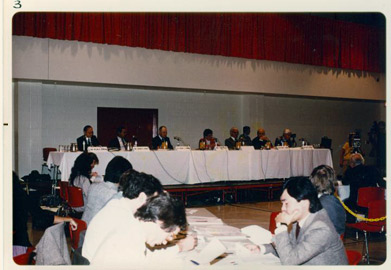
As part of its investigation, the CWRIC held hearings in Washington, D.C. and other locations to gather testimony from decision-makers and those who were affected by the internment. I was fortunate to attend the first hearing held in Washington, D.C. It’s funny sometimes, the things that stick in your mind, but one lasting impression I had of the hearing was the attention that focused on a short, well-dressed elderly man as he entered the Senate Caucus Room. I remember sitting near Shig Wakamatsu and noticed that he and some other Nisei fixed their gaze on this man that I didn’t recognize, but who clearly caught the attention of a knowing few. John J. McCloy was the assistant secretary of War in 1942 and had authority over the major decisions related to the internment. At the age of 86, he was fit and clear-minded, although his demeanor belied his position as one of the most influential men in America. McCloy maintained that the internment was justified. The final decision to hold a hearing in Chicago wasn’t made until June 1981. Min Yasui and John Tateishi had prevailed on the CWRIC Chair Joan Bernstein, and Paul Bannai, the CWRIC executive director, that Chicago was an important location. I had urged both Min and John to do all they could to pressure Bernstein and Bannai because the large numbers of former internees residing in Chicago and in the Midwest had important experiences to tell. I had been in contact with Paul Bannai following his appointment as the director of the CWRIC. On June 12, I toured Northeastern Illinois University for the purpose of recommending it as a hearing site. Up to that point, other potential sites included the City Hall Hearing Room, the Cultural Center, the Northwestern Law School and the Dirksen Federal Building. Northeastern Illinois University was finally selected. I continued my contact with Paul Bannai and on June 28, we met in Chicago to discuss witnesses and hearing procedures for the Chicago hearing.

Our most important hearing task was to identify and prepare witnesses to testify. I recall working closely with the Chicago Redress Committee to identify and prepare Chicago witnesses. At the same time, I coordinated a similar effort in the Midwest to identify and prepare witnesses from Midwestern cities. I recall working with John Tateishi and Minoru Yasui to put together a packet for JACL chapters related to the hearings. The packet outlined the hearing procedures and provided a template for written and oral testimonies. In Chicago, we conducted workshops and individual sessions with witnesses at the JASC on August 15, and at the Midwest Buddhist Temple on August 29, where we helped with the preparation of their written testimony and with their oral presentations before the commission. Though it was difficult to provide this same service to potential witnesses from outside Chicago, nevertheless I was able to assist a number of them with their written testimonies. In addition, I worked with the JACL chapters to identify witnesses who could provide compelling testimony. Maryann Mahaffey was one such individual. Ms. Mahaffey was then a member of the Detroit City Council, but during World War II she was a young social worker at Poston II. She gave emotional testimony saying, “I think I did some good. I think I helped. But I will be forever haunted by what could not be done, by the irreparable damage inflicted on an innocent, helpless and defenseless population.”

Bill Yoshino (lower right) at the Chicago Hearings of the Commission on Wartime Relocation

Redress Legislation in Congress

The CWRIC completed its investigation and released its findings in a report entitled “Personal Justice Denied” in December 1982. The commission concluded that the internment was not justified by a military necessity. It also said that the internment was caused by “race prejudice, wartime hysteria and a failure of political leadership.” Its recommendations included an official apology, $20,000 in compensation to surviving persons who were excluded from their places of residence, and the establishment of an educational fund to promote knowledge about the internment. These recommendations formed the basis for the legislation that would be introduced in Congress.

Following the issuance of the commission report, the JACL committed itself to gaining passage of legislation to incorporate the primary provisions of the commission recommendations. This effort would take six years, during which time the legislation was introduced in three separate sessions of Congress. The campaign also brought changes within the JACL to accommodate a more focused lobbying effort. The JACL formed a lobbying arm called the JACL Legislative Education Committee that had the ability to engage in more direct forms of lobbying. Minoru Yasui served as the chair of this committee and in 1985, Grayce Uyehara, a staunch JACLer from Philadelphia, was named as its executive director.

The effort to gain passage of the redress legislation was very similar to the effort to gain passage of the commission legislation, although, by degree, it was much more difficult because we were looking at a piece of legislation that would cost the taxpayers over $1 billion during a time of fiscal belt-tightening by a Republican Administration. Still, the legislative campaign in the Midwest focused on personal contacts with legislators, gathering endorsements by organizations and fundraising. My duties remained much the same from the CWRIC campaign. Min Yasui asked me to coordinate all JACL chapter and district council activities on redress. This meant serving as a communications clearinghouse for all incoming and outgoing information and data, which included the issuance of monthly reports. I enjoyed working with Grayce, who stressed close communications and always offered snippets of information such as when she heard that a small group of Senators were prepared to filibuster the redress bill upon introduction and that Senator Spark Matsunaga was working to diffuse the effort. It was her way of keeping people engaged on the issue.

It was a long haul from 1983 until 1987 when circumstances and events changed for the better, paving the way for Congress to finally pass the Civil Liberties Act. I recall working with others to get endorsements from a number of organizations including the Chicago City Council by arranging for JACL testimony at a committee hearing before Alderman Roman Pucinski. I will never forget the assistance provided by David Roth from the American Jewish Committee who worked through the Illinois Ethnic Coalition to gain the support of numerous organizations to do grassroots lobbying for the redress bill. I remember accompanying Chiye Tomihiro to talk to the chief fundraiser for Congressman John Porter to see if we could get him to convince the congressman to support the legislation. From time to time, I touched base with Congressman Sidney Yates, an old friend of the Japanese American community, to reinforce our thanks for his support. We knew eventually that we would also have to get the support of President Ronald Reagan, so I prevailed on my contacts to Republican Governor James Thompson to try to convince him send a letter to the President requesting his support. While a gesture such as this didn’t have a bearing in determining Reagan’s support, it was a way to get one more influential person to become aware of our cause. As a result of strenuous efforts by countless individuals, the House of Representatives voted to approve the Civil Liberties Act on September 17, 1987 by a vote of 243-141. The Illinois delegation voted 15-4, with three not voting. Senate action on the legislation finally occurred on April 20, 1988 when it voted 69-27 to approve the legislation.

As with the commission legislation, I was honored to be part of the JACL delegation to attend the Presidential signing of the Civil Liberties Act. At the time, I was attending the JACL national convention in Seattle. We boarded an overnight flight to Washington, D.C. The signing ceremony was held on August 10, 1988, in the press room in the Old Executive Office Building, where approximately fifty people gathered for this emotional event.

Office of Redress Administration

Following the signing of the Civil Liberties Act, I was appointed as the National Director of the JACL in 1989. The work on redress didn’t end when President Reagan signed the bill. Once the bill became law, there was the matter of getting the Congress to appropriate the funds to make the redress payments to individuals. As with the Civil Liberties Act, Senator Daniel Inouye again played a critical role. I recall that as this issue was under discussion, Cressey Nakagawa, the JACL national president, and I were called to a meeting with Senator Inouye. Senator Inouye did away with the pleasantries quickly and soon said, “What do you fellows think about an entitlement.” With that the senator had determined an approach where the redress payments would be first in line for funding. This, however, didn’t completely relieve the anxiety regarding funding because of ongoing efforts to cut government spending through measures such as the Gramm-Rudman Act.

The Office of Redress Administration (ORA) was established to implement the Civil Liberties Act, including the writing of regulations that governed important issues such as eligibility. In the end, and to their credit, the ORA interpreted the Act in a liberal manner. I believe part of the credit for this is due to Cherry Kinoshita from Seattle, a member of both the LEC and the JACL boards. Cherry closely scrutinized the work of the ORA and never hesitated to weigh in for the benefit of the community.

The redress payments commenced during the fall of 1990 when the Justice Department began circulating the apology letters. The ORA organized for local ceremonies in a number of locations including Chicago where the oldest recipients were presented with their checks. The JACL played an important role in assisting the ORA in implementing their program. Through the JACL network of regional offices and chapters, we assisted in the distribution of ORA materials and we provided assistance to individuals in completing applications to make a claim. I recall receiving many inquiries, most involving the issue of eligibility or the lack of documentation to show that a person resided on the West Coast. In all respects, the ORA proved cooperative and effective in the administration of the program.

And, Finally

In all the years I’ve worked for the JACL, I look back to the 1980s and the redress campaign as perhaps my most fulfilling experience. At the time, I couldn’t imagine an issue as being more important. I recently received a touching correspondence from John Tateishi where he said, “I’ve always felt there were two individuals who never received credit for their part in all of that (the redress campaign): Clifford (Uyeda) for his steadfast and willing support of whatever I thought to do; and you, for the many long days and nights and weeks and months we pondered the course of the campaign together and gave our hearts and souls to ensuring we would make the American public understand the importance of what we sought. You were always the silent partner in everything I did as the JACL’s redress leader, and I’ll be forever grateful to you for all your brilliance and effort, and so too for your many moments of wise counsel in the past seven years we’ve worked together.”

On Being Japanese American by Nicole Sumida

Growing up in the 1970’s in Chicago’s near west suburbs, there were few people like me. In fact, my sister and I were the only half Japanese, half Swedish/German girls on our block (or in our community for that matter). Most people thought I was Chinese and it didn’t take long to realize that “chink” was not a friendly word. As a kid, I gravitated towards the “others”, the few kids in the neighborhood who were Puerto Rican, Mexican or who just didn’t fit in. Despite being isolated from other Japanese or other Asian Americans, I always identified more with being Japanese, probably because of my appearance and my close relationship with my mother, who was born and raised on the Big Island of Hawai’i.
In high school, my Latino and African American classmates readily accepted me and didn’t seem to care what I was. While most of my Caucasian peers were equally welcoming, many didn’t quite know what to do with me. “Is she Oriental or White?” This was clearly an issue for some. They’d ask me dumb questions and at times make racist jokes not thinking I’d be offended. I knew a girl in high school who used to call my mother “Mrs. Miyagi”. (At least she got the ethnicity right).

When I started university, I decided to study literature and began reading books by people who felt marginalized and who were starting to define themselves on their own terms. I began to meet other Asians, particularly Filipinos, and I got involved in a local Filipino theatre group, Pintig. There I met many dedicated cultural activists who inspired me with their strong sense of identity and their passionate desire to sustain their culture in the States.

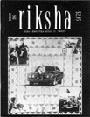
Cover of riksha magazine’s first issue.

My work at Pintig led to a friendship with Larry Leopoldo who shared my interest in starting an Asian American arts magazine. Over coffee in a café, we decided that the focus of our magazine would be works “by and about Asian Americans” and we named it riksha. When we put the call out for submissions, we began to realize that there were lots of people out there making their art, sharing their stories and starting to connect with each other. They all needed more exposure.

Over the next few years, riksha lived through many incarnations. Through the hard work of talented people like Larry, along with Alex Yu, Patty Cooper and Ed Eusebio (and numerous others), riksha published several magazines and held a variety of performances and exhibits in local cafes, art galleries and clubs. riksha collaborated with many organizations and helped to contribute to the dialogue that had started about what it meant to be Asian American.

Following university, I went to live in Hawai’i for a few years. I’ll never forget the first time I met some local writers/publishers. I started blathering on about the Asian American movement and they just stood there with blank expressions. “Asian American?” one of them asked (he was local Chinese). Then he just chuckled like he’d heard it all. What I later realized is that not everyone lives in a hyphenated world. And there are places, even in the States, where Asians are the majority and don’t feel the same sting of racism as on the mainland.

Of course, Hawai’i is not perfect and there are plenty of race issues to contend with there too. Just ask the Native Hawaiians. But it is a place where Japanese Americans, and other Asian Americans, have been at the top of the social hierarchy for years now and it’s also a place where hapaslike me (half-White, half any other race) fit in easily. I am ordinary there and being ordinary is a welcome reprieve.

While living in Hawai’i and spending time with my aunt and uncles, I discovered more about my family history. My grandfather, Ryoji Sumida, born in Hiroshima, left Japan as a young man in the early 20th century in search of work prospects in Brazil. When his ship docked in Hawaii, he and his brother decided to stay in the islands. No doubt it reminded him of his native city (something I realized on a recent trip to Hiroshima). On the Big Island, my grandfather, who was a fisherman by trade, started a business enterprise that would grow into a general store, a fishcake factory and a restaurant, among other endeavors.

When Japan bombed Pearl Harbor in 1941, martial law was declared and it was not long before the FBI started rounding up and interrogating prominent Japanese Americans. My grandfather was detained in Hilo and only through the help of a friend, an attorney who had been living in Hilo for many years, was he released after six long months. I had the opportunity to correspond with the attorney turned judge, Martin Pence, before he died. What struck me most was his willingness to step forward at a time when loyalties were being questioned. Of course, Judge Pence didn’t think of himself as extraordinary; rather he simply felt that an injustice has occurred and he needed to do something about it. My grandfather never forgot Judge Pence’s efforts on his behalf and my mother tells the story of the delivery of “special catches of the day” to Judge Pence for years following the war. A small gesture from a grateful man.

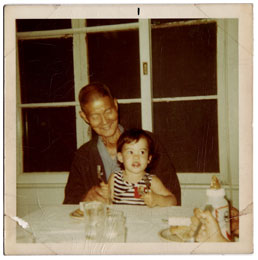
My grandfather died when I was ten years old and my memories of him are hazy now. On a shelf at home where I place special mementos, I often look at the photographs of him. One is with my 2-year old self in his lap and another is with him and several family members and employees in his general store. He was a stoic and practical man with his own children, but with us (his grandchildren), he was an altogether lighter person, quick to smile and play and who expressed his love through walks holding hands and naps curled up close. My mother told me that he would “light up” whenever my sister and I would visit him. He was a man who, despite his hardships and sacrifices, which included surviving the devastation of two tsunamis in Hilo, lived his days with a sense of gratitude and generosity that touched all who knew him.

The author as a child pictures here with her grandfather Ryoji Sumida

As I became more grounded in my family history, it became somewhat easier to deal with the more prickly aspects of being Japanese. While I had read about Japan’s atrocities during the war, learning to deal with it firsthand was another story. I remember my first encounters with friends whose families had been affected by Japanese occupation. Their stories were awful and I was often stunned and shamed into silence. I could tell that they felt badly telling me but they seemed driven by a need to tell someone, someone Japanese, and to be heard. As time went on, I found myself apologizing after these encounters. Perhaps it seems odd to apologize for something so removed from my own personal experience. But somehow, it just seemed like the right thing to do.

I remember one day, when I was first dating my now husband (who is Filipino/Chinese), I met the aunt of my father-in-law who had immigrated to Chicago many years ago. She proceeded to tell me the horrific tale of her husband’s murder by imperial soldiers in the Philippines and how she was left to raise her small children on her own. The details of her story were so vivid, as if she had experienced the loss only a short time ago, and her emotions were still raw. I knew she didn’t blame me personally but she needed me to hear her and, for a moment, feel the discomfort of her tragedy. She held my hand as she told her story and I felt a small reconciliation take place. This is a burden that we Japanese carry, but it’s also an opportunity, a chance to extend our compassion and interrupt the cycle of pain that continues to this day.

After living in Hawai’i, I traveled and lived in different places and later decided to come back to Chicago. I returned to study and became a clinical social worker. I currently work with children and families in an outpatient mental health center. If I can instill just a bit of hope or offer assistance to cope with a difficult situation, well then, it’s been a good day. And what I learn from the people I’ve met only reinforces my belief in resiliency and, ultimately, gratitude for the simple things, an awareness instilled in me at a very young age by a very wise man.

Over the years, my involvement in the Asian American arts has diminished in favor of other pursuits, but I continue to support the community. The loose collective of riksha members continue to talk about what we might offer in the future. Times have changed and organizations like riksha are needed less in a world where our artists and writers know how to promote themselves in expedient ways, but we’ll keep the dialogue going and see where it takes us…

Connecting Cultures through Kimono and Sari by Dean Raffaelli

On a February morning when a faint hint of spring was in the air, a diverse group of Chicagoans gathered at the Indo-American Center on North California Avenue to discuss how attire and appearance impact the Japanese American and Asian Indian American communities. Present were representatives from the Field Museum, the Indo-American Center, and the Chicago Japanese American Historical Society.


This was the second planning session for Cultural Connections Program, a program administered by the Field Museum’s Center for Cultural Understanding and Change (CCUC). The CCUC brings the museum’s anthropological mission into the neighborhoods of Chicago by partnering with more than twenty ethnic museums and cultural centers. The theme for this year’s programs is “The Language of Looks.”

I was asked to join because in the twenty years I have been associated with the Chado Urasenke Tankokai Chicago Association, I have become adept at the arcane practice of wearing kimono. Our association consists of teachers and students dedicated to the study of Chanoyu, the Tea Ceremony. To that end, I have acquired a custom made, dark blue silk kimono with all the accompanying accessories. More importantly, I have learned how to wear it properly. My first thought on being asked was why not ask a Japanese-American male to model kimono? Little did I know that this seemingly simple question contained within it the basic conundrum of the entire program.
Although we were there to plan the event, I found myself in the midst of one of the best history classes I had ever attended. My fellow attendees commented not only on history, but also on demographics, anthropology, theology, philosophy, and no less important, fashion design.

I learned that Japanese history in the United States began with the Meiji period, some 150 years ago when Commodore Perry’s “Black Ships” forced Japan to open its doors to the West. The first Japanese immigrants to America were farmers and agricultural workers. Their history in America was complicated by import quotas, exclusion laws, picture-brides and darkest of all, forced internment and resettlement.

This contrasts with the more recent history of an urban Asian Indian culture that migrated to America in the 1960s during the Cold War in response to a need for professionals, mainly scientists, engineers and doctors. They had the advantage of speaking English and being able to settle wherever the jobs took them. There was no need for them to be segregated into towns, as the Japanese were on the West coast.

Their disparate backgrounds have seen the Japanese strive for inclusion while the Asian Indian’s inclination has been to blend and reshape American culture. To think of this in real-time, count how many women you have seen in sari versus kimono. It would be thousands to one.

The title of the program is “Mirror, Mirror on the Wall…How Am I Perceived By All?” As the afternoon proceeded, I watched various presenters discuss how history, politics, economics and culture play a role in how they dress as individuals. It became apparent that social status, gender, group affiliation, profession, values and taste all contribute to the every day decision of what to wear.
To complicate matters even more, all the above is dependent on the resources available to us. Our communities’ accumulated knowledge and creativity combined to affect how we perceive ourselves and how we are perceived by the society at large. And you thought dressing for work in the morning was simple.

My experience prior to the conference had been with my colleagues in the world of Tea where not wearing a kimono is noticed more than wearing one. Individuals that revel in their ethnic dress have surrounded me and left me ill prepared for the numerous issues and the intensity of emotion related to dress. As culturally aware as I think I am, I am still a white male living in a world designed by and for white males, and before the Cultural Connections event I would have never understood this depth of feeling.

Part of our presentation was to demonstrate the complexity of dressing in kimono. In our casual age of buttons, zippers and Velcro, the art of dressing has been lost to most of us. Of course we learn to tie a scarf or a tie, but these pale in comparison to tying an obi.
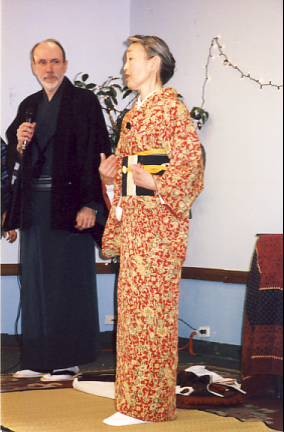
Joyce Kubose, a long time student and teacher in the Urasenke tradition of Tea, performed the seemingly impossible task of applying her obi in less than ten minutes. This task would take most of us not only much longer, but also would require an assistant. She perfected this skill while training at the Urasenke Headquarters in Kyoto for three years where kimono was the mandatory daily dress. Because of this unique experience, she differs from the vast majority of Japanese–Americans.
My initiation into wearing kimono began at the direction of Joyce Kubose, my tea sensei. She was the first teacher to encourage me to wear kimono. She understands that kimono is integral to the study of tea and not just a costume. I have become accustomed to and comfortable in my kimono and never forget that it is not a direct part of my cultural heritage, but a privilege extended to me by the Japanese-American community.

What is ethnic dress after all but cloth? It is just there, unless drawn attention to, as in couture. It is what grandma and grandpa wear, and what culturally aware youth use to play off of: sari with jeans and high heels, coats and accessories made out of antique kimono fabric. For most, ethnic dress is only brought out of the closet for important milestones: birth, coming of age, marriage and death. It is not a comfortable part of life for many people.

A perfect example of this was the story told by a young college-aged Asian Indian woman concerning nose piercing. Her mother was shocked to find out she had gotten her nose pierced while away at college, but her grandmother was so happy that she bought her multiple nose rings. It was as if her ethnicity skipped a generation before reasserting itself. Her mother had done what she could to fit in and her daughter had found a way to blend tradition with the fashion of the day to make a strong personal statement.


When I look out at the audiences that come to see us demonstrate the Tea Ceremony, I often wonder why there are not more Japanese-Americans, especially children, young adults and males, in attendance. Although this may be presumptuous of me to say, my wish for the Japanese-American community is not to deny, but to rediscover their ancient heritage. Ultimately I think this is the only path to inclusion.

So in the end what are we left with? Someone at the end of the program commented that the topic should not have been the Language of Looks but the Calculus of Looks because dress is the outcome of multiple variables. It is an adaptation, over hundreds of years by millions of people, in response to the world in which they find themselves. Sometimes they find themselves in favorable circumstances and sometimes in dire ones, but they are always looking to the future and to what will be the best for them and, more importantly, for their children, though they seldom realize this until they themselves are parents and grand parents.

Day of Remembrance 2006 by Jean Ikezoe-Halevi

Issei, Nisei, Sansei, Yonsei, Gosei. It never occurred to me that I would live to see five generations of Japanese Americans, but I have.

When Japan bombed Pearl Harbor on December 7th, 1941, our country was thrown into turmoil. Most of the world was already involved in what would be known as World War II, and now the United States was dragged into it. Old feelings of racial prejudice reared up against Japanese Americans, who were considered a threat to this country by some now that we were at war with Japan. Despite evidence by government organizations, including the F.B.I., that Japanese Americans were of no threat to their own country, President Franklin D. Roosevelt signed Executive Order 9066 on February 19, 1942.

With the stroke of his pen, Roosevelt sent more than 120,000 Japanese Americans into internment camps in some of the most remote parts of the United States. Two-thirds of these people were American born citizens who were deprived of their basic rights. The rest were immigrants who could not become American citizens because of their race and ethnicity. Roosevelt could not have foreseen the long term psychological effects that Japanese Americans would have to endure as the only Americans who were interned en masse because of the mistaken belief that race meant loyalty to another country, in this case Japan.

To understand the long term effects, you have to differentiate between each of the generations involved. The Issei were the Japanese pioneers; the immigrants who came to the United States in the early years of the 20th century seeking a better life, and as adults with families, ultimately bore the burden of the internment camps. The Nisei are their American born children, who also went to the internment camps; many were young adults at the beginning of WWII, but there also were teenagers and children, including babies born in the camps. The next generation is the Sansei; most are now middle aged Baby Boomers, who were born in the mid 1940s through the mid 1960s. Their children are Yonsei, mainly Generation X-ers, followed by the fifth generation Gosei.

Although most of the Issei are gone now, what they lived through during and after World War II, has had ramifications on the generations that followed. It was because of this that the “Day of Remembrance 2006, Commemorating the Signing of Executive Order 9066” program addressed “Identity: Post Internment – Generational Effects of America’s Concentration Camps.”

The program was sponsored by The Chicago Japanese American Historical Society, The Japanese American Service Committee and The Japanese American Citizens League, Chicago Chapter. Walking into the event on Sunday, February 19th at DeVry University in Chicago, I wasn’t sure what to expect.


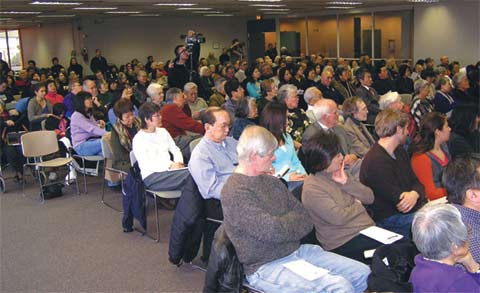
The first thing I found interesting was the crowd size. On this freezing cold and windy day, almost every seat was filled when I arrived, and more seats had to be added. By the time the program started there were more than 200 people in attendance. The audience was filled with Japanese Americans of various ages and a number of non-Japanese Americans as well.

The program started with opening remarks by David Lear, Chairman of the 2006 DOR Committee, followed by a reading by 9th grader Lisa Doi of “Executive Order 9066,” which was signed by Roosevelt sixty-four years ago to the day.

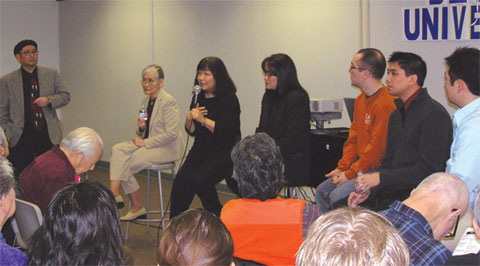
The moderator for the program was Gil Asakawa, author of “Being Japanese American.” The panel members were divided into generations. Representing the Nisei (second generation) was Molly Ozaki, who referred to herself as part of the “bridge generation” between Issei and Nisei. Marlynne Nishimura represented the Sansei (third generation). Yonsei (fourth generation) representatives were Brandon Mita, Alec MacDonald and Erin Yoshimura. Dru Yamagiwa represented the Gosei (fifth generation). The panelists came from a wide variety of backgrounds and occupations, but shared similar stories.

Asakawa set the tone of the program saying that while the “Day of Remembrance” should be a “somber” occasion, “humor and wit is a great way to pass down information.”

On the question of how has the internment affected generations, Molly Ozaki said that after leaving the internment camps, Japanese Americans were not allowed to congregate with each other or build “Japan Towns.” They learned not “to be conspicuous.” Considering that approximately 30,000 Japanese Americans came to the Chicago area after leaving the internment camps, this was not an easy task.

Marlynne Nishimura spoke of “silent expectations” and “passing down positive values to her children.”

Asakawa posed the question of whether or not there are issues that have been passed down and how that has hindered or helped them.

Erin Yoshimura said that because of the internment her parents had a “huge fear of the judicial system and police.” She said her father was always telling her not to speed and to stay out of trouble. Her mother said she didn’t know what she could or couldn’t say.

I was very moved by this intergenerational program. So many of the issues that were brought up hit home to me. For example, college student Brandon Mita said that in some situations he does not speak up for himself when needed. He told a story about when he was working for a company and wearing their uniform he had to make a delivery. Arriving at his destination, a man there thought Mita was delivering Chinese food that he’d ordered. Mita said he should have spoken up to correct the man, but didn’t. How many Japanese Americans have faced a similar situation?

On the other side of the coin, Dru Yamagiwa said that he is outspoken on some issues, such as when he saw a driver bumping his car while parking and yelled at him. He attributed this to the way he was raised.

On the subject of Japanese values, Asakawa described the words Gaman and Shikata ga nai as “Take It Vs. This Can’t Be Helped.” He said, “These mantras helped the community through difficult times.”

Other topics covered included the shrinking Japanese American population and the high rate of racial intermarriage. Comments and questions from the audience also were taken.

Alec MacDonald gave his view of what it’s like to be a Japanese American without a history of internment. His father is Caucasian and his mother is a Hawaiian Japanese American, who was not interned. He also addressed his own need to learn more about being Japanese American because of his diverse heritage.

Near the end of the program David Lear told a story about how he, as a student at one of the country’s top schools, received a failing grade a few years ago on his project about the internment. His teacher was a Roosevelt scholar who didn’t share his view.

Of the internment Lear said, “We have a moral obligation to share with our children.” In closing he asked the audience to ponder the question, “How did the internment affect me as a human being?”

Listening to the stories of the panelists, I saw that what people experienced during the internment is slowly winding down through each succeeding generation. The internment had been a binding experience for the Issei and Nisei generations, both physically and emotionally. Now that we are three generations removed from it, Japanese Americans are learning to deal with it on a historical note as well as a personal one.

Looking at each generation you could see that the younger generations have become stronger and more outspoken. They don’t have to fear what their grandparents and great-grandparents lived through, although they still have to confront racism on their own terms. In the words of Marlynne Nishimura, “We should never let our guard down and think that everything is fine.”

What I took away from the “Day of Remembrance 2006,” is the knowledge that I am not alone in some of the things that I’ve felt and experienced. As Japanese Americans we not only have a shared history, but a shared future.


Sports, Community, and History: Reflections on Recording the Japanese American Experience in Chicago By Alec Yoshio MacDonald

Outside, the bone-chilling February winds are blowing fiercely off of Lake Michigan, but inside, the buzz of the crowd seems to provide as much insulation as the sturdy brick walls of the old gymnasium. The spectators draw their energy from the teams’ frenzied movements down on the basketball court, as the players in turn feed off of the cheers from the stands and pick up their intensity. Due to the heated atmosphere of the game, everyone forgets the icy Chicago winter for the moment. Virtually no one in attendance was born in a place where they had to endure such a harsh climate, so the diversion from the inhospitable weather is welcomed all the more. The squeak of sneaker soles, the thump of the old leather ball, and the occasional swish of a made basket create a sense of revitalization, pushing back the mundane concerns that everyone must face tomorrow, after the weekend is over…

This is one image I have of the Chicago Nisei Athletic Association, a collection of sports leagues formed in 1946 by Japanese Americans who, after leaving World War II internment camps, resettled in Chicago. My various impressions of the CNAA come from reading about it, perusing its archival photos, and – most notably – talking to its former members. In total, I recorded conversations with ten individuals who had been involved during the organization’s first decade. Those interviews now constitute the basis of an on-line multimedia gallery entitled “Japanese American Team Spirit: The Chicago Nisei Athletic Association” that is being hosted by the Chicago Japanese American Historical Society. At the request of the CJAHS, I am offering this brief article to explain how and why the gallery came together.

First inspired by a CJAHS photo exhibition on the CNAA, I set out to learn more about it from the original players. Obtaining interviews presented a bit of a challenge, as many of the folks who had participated in those early years have either passed away or returned to the places they lived before the war. The people whom I did get into contact with, however, were very accommodating, and provided me with a wealth of intriguing and exciting information. These older men and women graciously let me into their homes to share a glimpse of their past, allowing me the pleasure to sit down with them and delve into the history of the Japanese American community.

They told me of journeys that started in childhood out west, moved through assembly centers and internment camps during the war, and eventually led along circuitous paths to the Windy City. Here in Chicago, they made new homes for themselves in a completely different environment than that which they knew previously, settling into what residences were available, reentering school or finding work, and developing routines to live by. And as young people, they naturally sought out a little fun and recreation as well. It was the CNAA which helped fulfill this need, furnishing a space where they could meet others with similar backgrounds and keep physically active in spirited competition.

I mainly asked about basketball, since it had been the CNAA’s hallmark sport from the beginning. The interviewees told me what they could remember about their playing days – which teams they were on, how the leagues were structured, who the sponsors were, when and where games were scheduled, and so forth. They spoke of winter Sundays at the Olivet Institute on the north side of town, where droves of Nisei gathered to watch boys’ teams (such as the Broncos and the Collegians) or girls’ teams (like the Debonaires or the Silhouettes) match up on the hardwood. They talked about meeting with friends at league dance parties on nights before games, and hanging out at the soda fountain after a lengthy slate of action wrapped up on game days. And they went on to describe how CNAA squads on occasion traveled to tournaments across the country in search of fresh opposition (although one of the most intriguing non-league contests occurred within city limits, as the CNAA’s Huskies had the chance to square off at the old Chicago Stadium against the semi-pro Stags – the precursor to today’s NBA Bulls franchise!).

The interviewees didn’t recollect every single solitary detail from those far-off days, but they all displayed an air of fond nostalgia that communicated volumes. It’s easy to fathom not only how the CNAA brought plenty of personal enjoyment to its individual members, but also how it produced a broader feeling of kinship within the Japanese American community. Following an internment experience that told these folks to be ashamed of their collective ethnic heritage, it seems like the CNAA filled in to try and reconstruct the foundations of Nikkei group identity. I will say that, from what the interviewees said, it sounds like the organization did little to dissolve the subtle barrier between Issei and Nisei that had formed during camp; however, the leagues certainly created a solid social network that greatly benefited the younger generation. Within this network, Nisei were able to find friendships and a sense of belonging that gave them the stability and strength necessary to thrive in what was unfamiliar and intimidating territory. Beyond the years spent adjusting to relocation, though, the bonds they forged then would last a lifetime (and in fact, some participants even met their future spouses through the leagues). I have to believe that the CNAA played an important role in keeping the community intact, helping prevent it from falling apart after the devastating effects of internment had shaken it to its core.

Healing and rebuilding, I think, are the aspects of the CNAA’s legacy that reveal why the organization deserves attention and recognition. Studies of Japanese American history tend to revolve around interment, and while that terrible event must not be forgotten, neither must the memories of how people found ways to recover from it. Those memories contain more than treasured moments from the past, but also lessons about how we progress into the future, showing us the effort, teamwork, and spirit required to keep a community alive.